The Carmalarky Dispatch #04
Why Don’t We Have Hovercrafts Yet?
From Marnie Aulabaugh
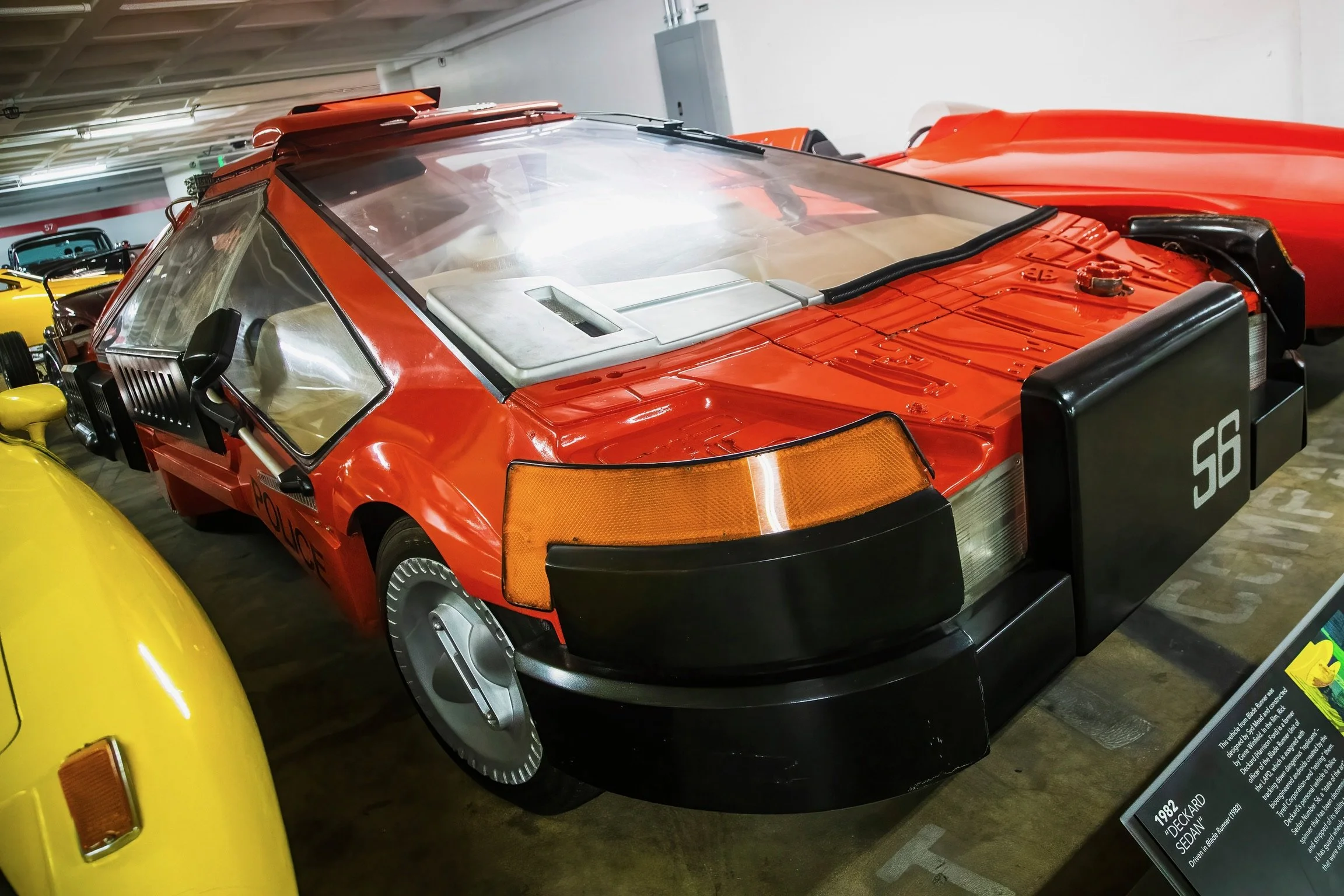
My initial attempt at this introduction was the first time I had space to write in months. I mind-dumped pages and pages of angry, confessional, random words to introduce this Dispatch then celebrated by reading the entirety of Philip K. Dick’s Do Androids Dream of Electric Sheep? (the inspiration for Blade Runner) in one sitting. If the short and simply written plot eludes you it goes like this: Rick Deckard, a bounty hunter in the far away future of 2021 drops in and out of Northern California in his hovercraft killing andys (androids who are very human). I locked in on “hovercraft.” Why don’t we have hovercrafts yet? In honor of the elusive hovercraft I scrapped most of what I wrote to introduce this, our fourth, “Carmalarky Dispatch,” via hovercraft-style mental drop ins. Short, simple, dramatic. You can feel me reaching here for a thematic structure, can’t you? It’s been that kind of year. I am guessing for many of you this is also true. But come on! Hovercrafts are so cool!
Life here at my side of the Carmalarky headquarters has been in disarray with the passing of my father-in-law Stanley after a battle with dementia and the relocating (twice in four months) of my own parents who then proceeded to fall, break bones, set up residency in the ICU, and catch a bad case of lingering hospital delirium. I put my novel on hold and am working on Carmalarky in fits and starts in between doctor appointments, moving and unpacking boxes for Momndad, homes full of kipple, driving to and fro with or without the elders, making appointments, attending surgeries, and of course taking care of myself ha ha (the women are laughing at this idea of taking care of oneself while we take care of others—I can feel you and am with you and hear you). My productivity is illusive, resulting in me feeling as if I am letting everyone down: my husband, daughter, my parents, David, writing partners, friends, my novel, even our dog Tod. However, when I tell people what is going on in my life they always understand. The elder parent care card is a lot like the cancer card except nearly everyone gets one at some point. Mention it and you get a pass and hopefully a hug.
Throughout all of this I am not beyond recognizing that working with the writers and artists featured in our upcoming issue has been a shiny happy thing since submissions opened in March. We have short stories featuring a lost car, a yellow car, a bus, and a classic Jag. We have a detailed diary of a Datsun resurrection. We have photography and paintings so fine you will want them on your walls. We have an epic poem about Henry Ford, a haibun about gas money, an essay about performance-artist race car drivers, and meditations on the motor vehicles we utilize in our search for home. So much creativity and unique thinking that David and I were blown away and overwhelmed and now we are just very proud. Editing is in the final phases. Pages are being designed. We have a virtual cork board with everything pasted up like the Issue-In-Progress wall from The French Dispatch that we can share from wherever we happen to be on this planet and are making use of vidphone calls to strategize. I can’t believe I get to do this! The size of the finished issue will fit in your glovebox and come in around 300 pages. It will be a four-color, thick paper, journal of autocentricities. We can’t wait for you to see it.
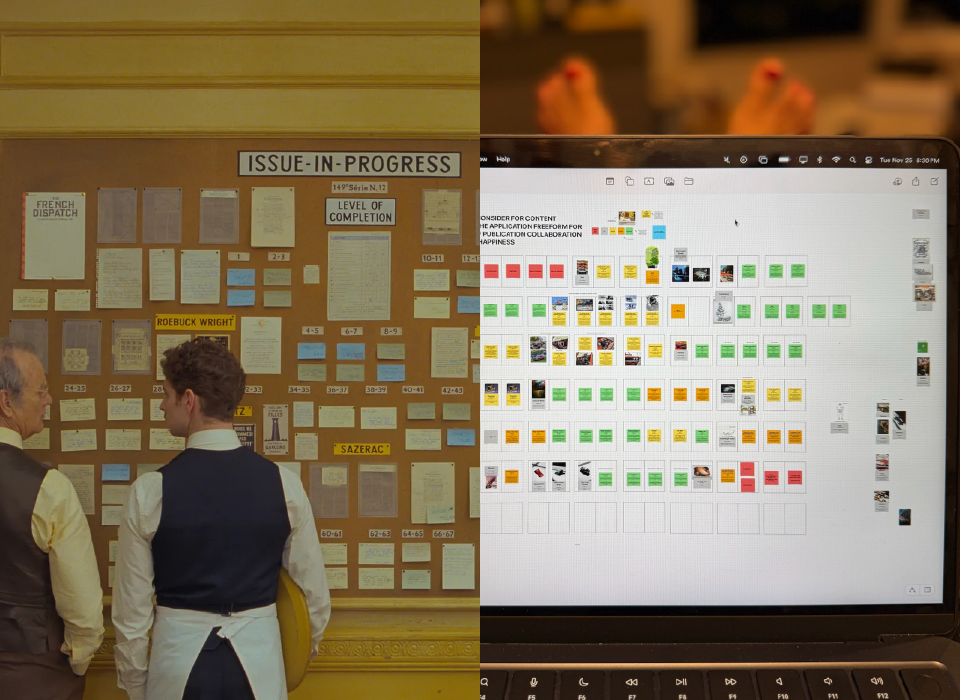
Left is The French Dispatch, right is Carmalarky. Same same.
A little over two years ago David and I sat on my back deck and smoked an entire joint from a jar labeled “one hit only” and decided to start up an auto-themed literary magazine called Carmalarky. Now I look back over the last six months and think, “was this summer of submissions and reading and editing and decisions and big life changes even real?” Then I scream and cry in my Dad’s 2016 Porsche Cayenne Diesel that I drive when I am with my parents in Colorado. I think this metallic-gold platinum edition Cayenne that I named Rachael dreams of racing wild horses, snowy two-lane roads in the Sierra Nevada, and an overland upgrade that includes a lift kit, bug lights, snorkel, and orange racing stripes. She dreams also of becoming a hovercraft. If we all just had a hovercraft.
See you soon,

Other links
elusive hovercraft
WSJ gift article where Dan Neil test drives and reviews a hovercraft flying car thing. Worth the click for the opening video. (This is why we don’t have hovercrafts.)
Issue-in-Progress
Shout out to Freeform, the program everyone with iOS or MacOS has but no one knows about.
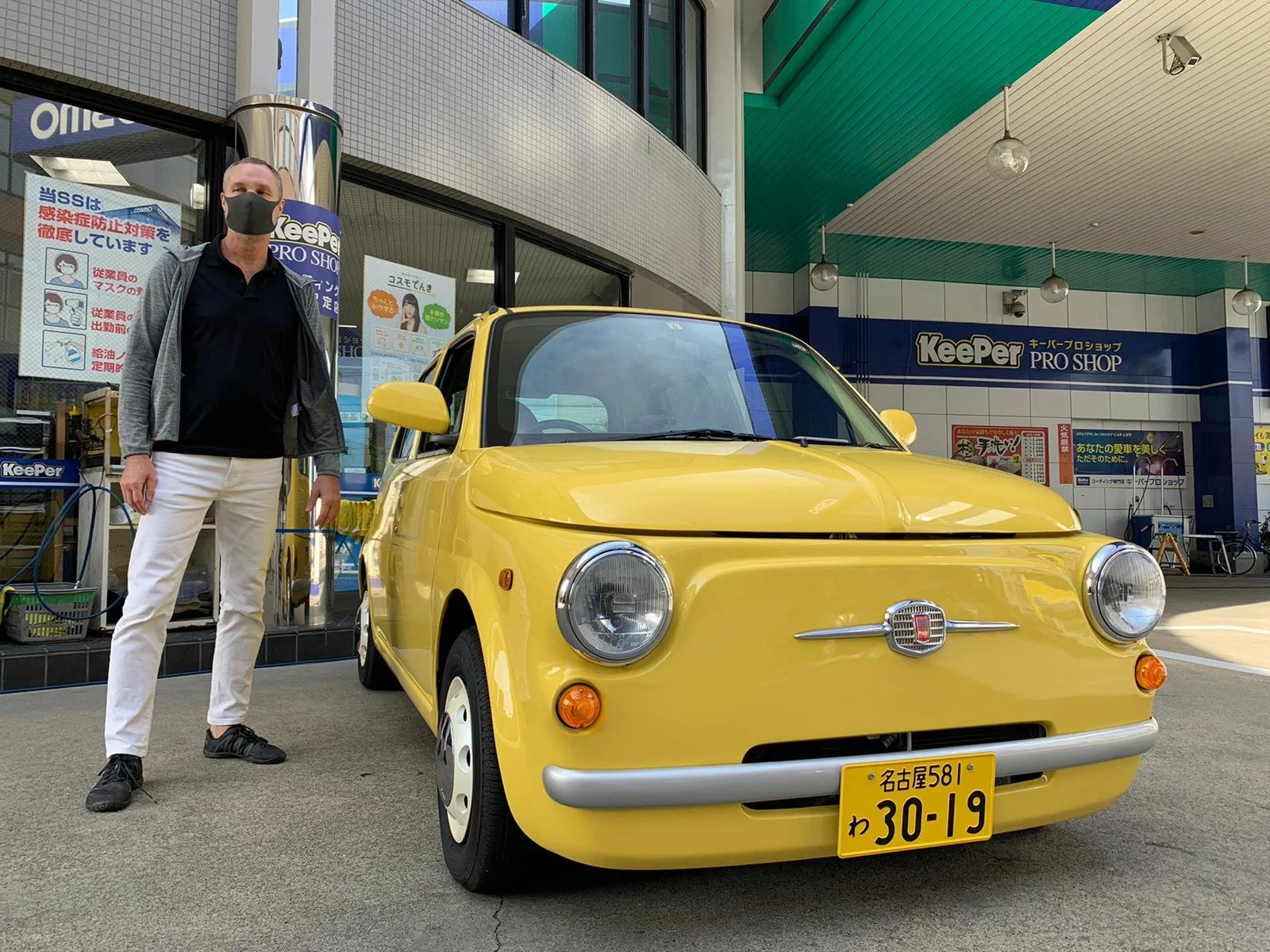
First drive in Japan, 2020
Getting My Japanese Driver’s License
From David Wishart
I live in Tokyo, and much like when I lived in New York, I function perfectly well without a car. Most people here do. Owning one is more of a luxury or a hobby than a necessity. But occasionally I want to drive to more out-of-the-way places, and rent something small, efficient, and visually unassuming. For this simple convenience, I have a Japanese Driver’s License. I capitalize this out of respect, but also pride, because getting it was a journey of driving skill, cultural awareness, and carefully managed frustration.
Citizens of many countries (England, Australia, France, Sweden, Taiwan, etc.) who live in Japan can simply exchange their home-country licenses for Japanese ones. For Americans, it’s a challenge of following rules, overcoming bureaucracy, and demonstrating driving skill. I wanted the freedom and fun of exploring Japan by car, so I began the process—daunted, yet determined.
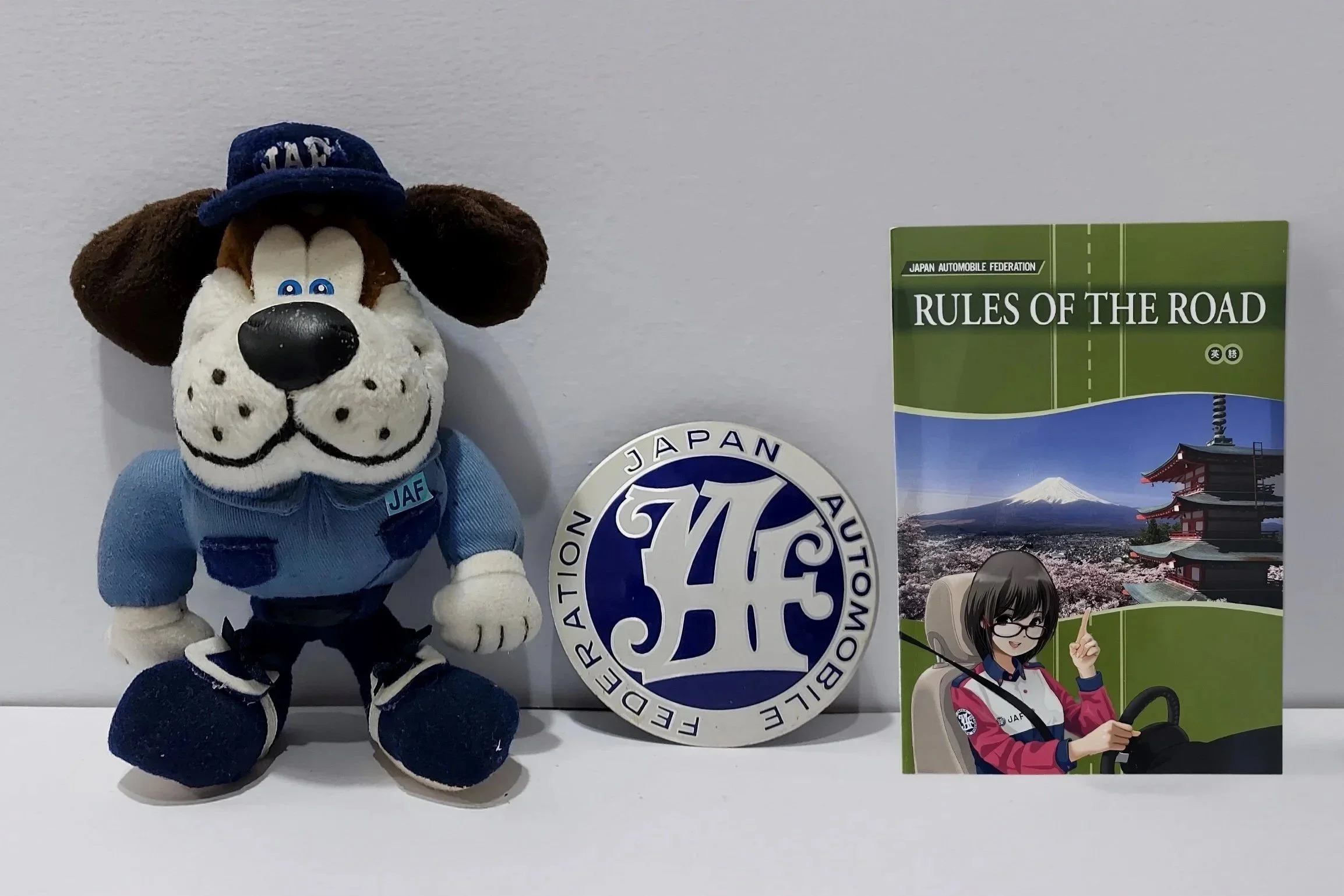
Japan Automobile Federation mascot, badge, and booklet
Step 1 - Translation and Traffic Law
I visited the Japan Automobile Federation (JAF) and applied for an official translation of my California license. The JAF is similar to AAA in the U.S., but with a canine mascot named Jackie the Dog (because everything in Japan has a mascot). I paid about $30 for my translation, which came with Rules of the Road, a cheerfully thorough foreign-language booklet explaining Japan’s traffic laws in heroic detail. So. Many. Rules. I studied them all with sincerity.
Two weeks later, my translated license arrived. Onwards!
Step 2 - Proof of Driving Life
Next, I had to prove that I had lived and legally driven in my home country for at least three months. This annoyed me, as I’ve been a licensed driver since 1982. But rules are rules, so I dug up income-tax returns, credit-card statements, rental receipts, utility bills, and driving records from the states where I was licensed to prove I’d been living and driving in the United States.
That was only the beginning. I had to supply my passport, Japan Residence Card, National Insurance Card, U.S. driver’s license, expired U.S. license, proof of my current Japanese address, and two correct-sized, recent photos.
Along with this came a stack of Japanese-language forms to be completed and presented in person at the Driver’s License Center. I kept everything organized in multiple document sleeves, partly for sanity and partly to impress the officials who would be reviewing them. I hired a specialist, Ryoko—part translator, part sherpa, part saint—to help me.
Gathering these relics of my past life took about a week. Then Ryoko scheduled my first appointment: document inspection day.
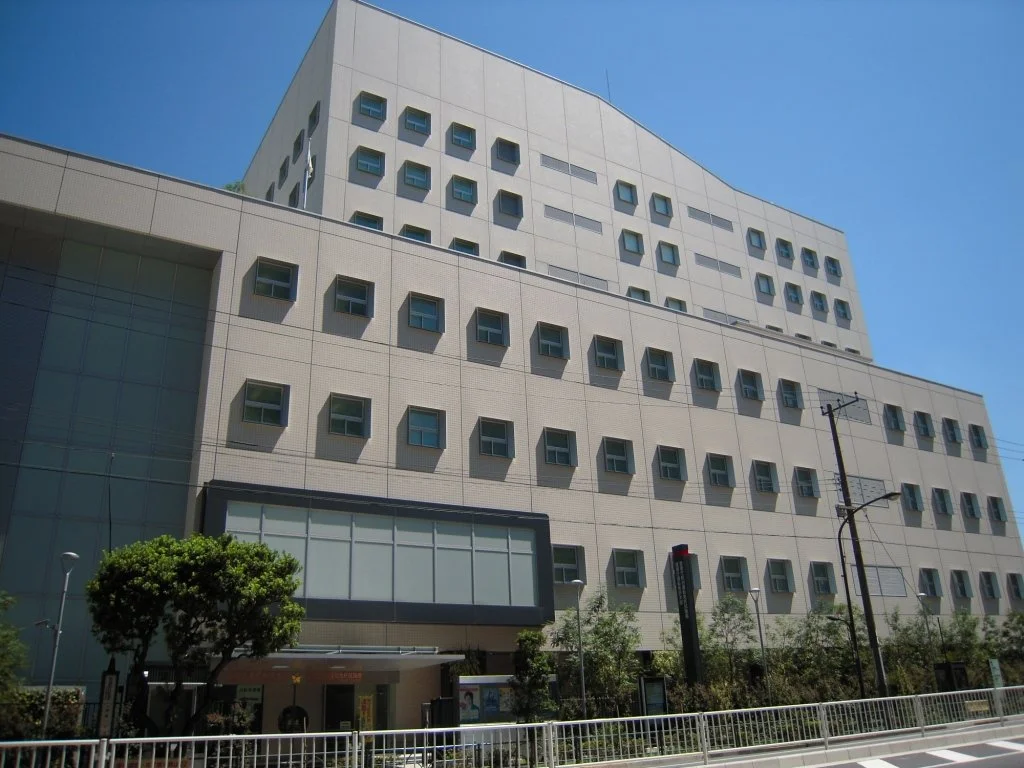
Samezu Driver’s Driver’s License Testing and Issuing Center
Step 3 - Document Inspection and Written Test
At 7:50 a.m., I met Ryoko outside the Samezu Driver’s License Testing and Issuing Center. Located in east Tokyo, the activity inside this institutionally bland building felt like something out of the movie Brazil, humming with activity and paperwork, but bathed in fluorescent lighting. It’s pleasingly orderly. There’s even a restaurant.
After a series of body-numbing activities—standing in lines, presenting documents, sitting in waiting rooms—accompanied by the constant soundtrack of ticket numbers being called in a gentle, reliable voice, it was finally time to present my paperwork. Everything was reviewed systematically, some items accepted immediately, others requiring further explanation. My limited Japanese prevented me from answering questions directly, but Ryoko knew my story and handled everything. My documents did their job: I had proved that I lived and legally drove in the U.S.
Next came the written test, thankfully in English: ten questions and a score of 70 to pass. Easier than expected, but no complaints from me. I’d studied for weeks. I passed.
After a quick vision test and scheduling my practical exam, I bowed my arigatos to Ryoko-san. It was 2 p.m.—six hours after I’d arrived. Back home, I poured myself a celebratory Suntory highball and reflected. My name, neatly written on countless forms, was now swimming in the sea of Japanese bureaucracy.
Step 4 - The Driving Test
The Japanese Practical Driving Test is the source of fear and anxiety for everyone who wants to drive here. Fewer than 35% pass on their first try, and many fail on their second, third, and fourth attempt. You start with a score of 100, and you must finish with at least 70. Points are deducted for any error, even something as small as not turning your head enough when checking your mirrors. Subtlety is not rewarded.
Most people avoid the stress and uncertainty by going to an authorized driving school. Lessons can take four months and cost around ¥300,000 ($2,500). I knew how to drive, but I didn’t know how to drive The Japanese Way. So I took lessons aimed only at passing the exam. This would be challenging: aside from a brief stint in Thailand, I had never driven a right-hand-drive car. Naturally, I made it harder by choosing to test with a manual transmission—because I am a superior, analog person—and Japan has a separate license for that.
My first lesson was scheduled the following week. I began to study and prepare myself for what became a vehicular ballet of precision and mental acuity. It begins before you even start the car, as you are expected to walk around the vehicle and check for cats. The starting routine:
Check front and bottom of car.
Check back and bottom of car.
Check for traffic before walking to driver door.
Check for traffic before opening door.
Check foot brake is engaged and car is in neutral
Adjust seat.
Adjust mirrors.
Put on seat belt.
Ask if I may start the engine.
Step on brake, start engine
Engage first gear
Check over right shoulder, signal right, check again.
Drive.
I came to view this as a game and practiced this exaggerated routine at home—accompanied by the deep groove of Bootsy Collins—using a chair as the driver's seat, imagining the invisible car around it, and building muscle memory for every movement.
Once driving, additional challenges awaited: lane change, obstacle avoidance, hill start, the S-curve, and the infamous “Crank”, a zig-zag of two 90-degree turns lined with traffic cones just wide enough for your car. Touch a cone or curb and you fail.
Thankfully, there were plenty of resources, like YouTube videos of experts practicing on the driving course. They helped. They also scared me. I spent hours watching, memorizing the course, absorbing Japanese traffic rules, and even riding my bicycle while rehearsing the exam, worried that I might fail and have to reschedule (and pay for) another attempt.
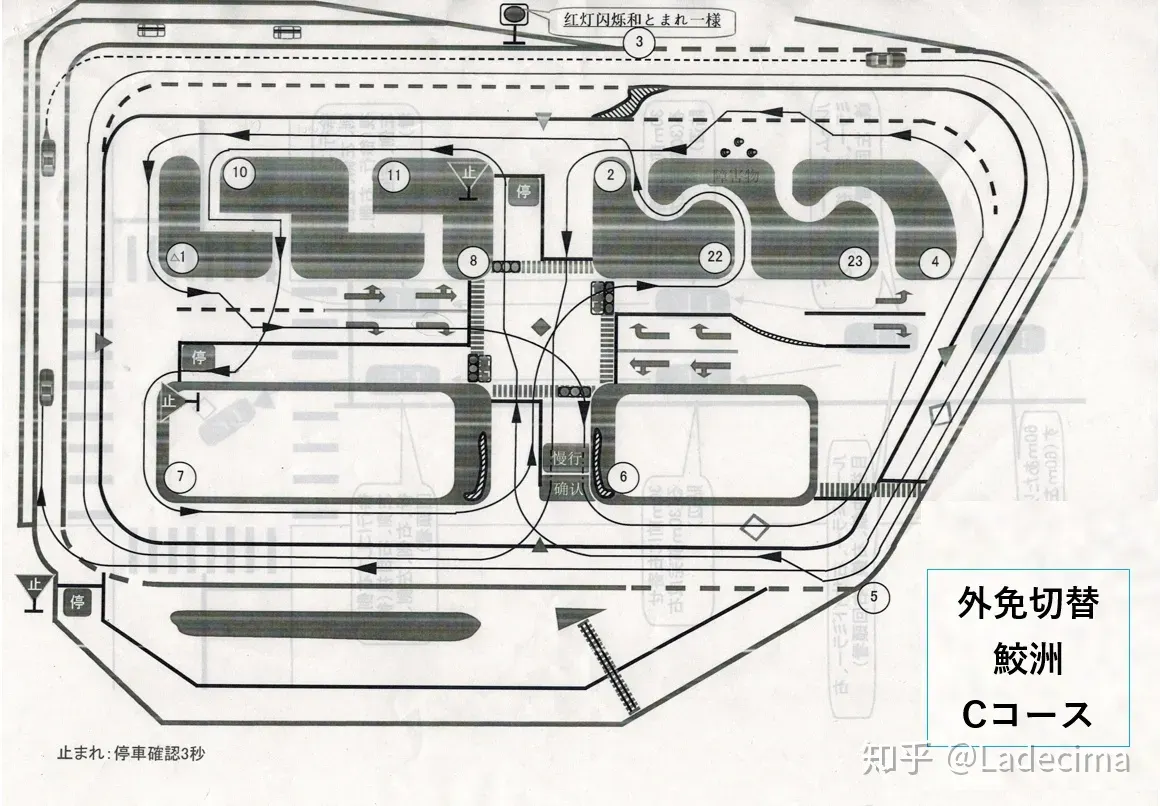
Course C at Samezu, one of three routes to memorize.
Step 5 - Lessons
I had two driving course lessons with different instructors. The first was driving a manual-transmission Toyota Crown Comfort, a very basic 4-door sedan. It’s commonly used as a taxi, a smaller Japanese take on the Ford Crown Victoria. It was a good match for my instructor, a clearly experienced older man, who balanced light-heartedness with the serious work ahead of me. After this, the course was no longer a mystery, just a path to memorize.
The second lesson was with a younger instructor in a modern Honda sedan. He taught me how to keep the car precisely centered between the lane markings. In left-side traffic, every instinct I had was flipped, so that precision mattered. This wasn’t perfunctory work. These were real skills I still use. As my final lesson before the exam, every detail counted.
Step 6 - The Driving Exam
Returning to the now-familiar Samezu Driver’s License Center, I met up with Ryoko again. We got in line. I showed my documents. Once the paperwork was done, I headed to the examination room to join the other candidates.
Sitting there, tracing the course map with my finger and watching people get called one by one for their exam, I considered everything that had led to this moment. I felt an obligation to succeed for the people helping me: the tireless Ryoko-san, my patient instructors, the always-polite driving center staff, even the bureaucracy itself. They had put in effort for me. I had to do my best.
Finally, my name was called. I left the room and walked out to the driving course. My heart raced. I tried to breathe.
Twenty minutes of vehicular pirouettes, arabesques, and jetés later, I completed the driving exam. I passed. In my group, only three out of about twenty-five passed. I know this because everyone else was asked to leave the room in a line of shame. I tried not to look. I looked anyway.
Does that sound like bragging? It kind of is. I earned this license. I deserve to drive.
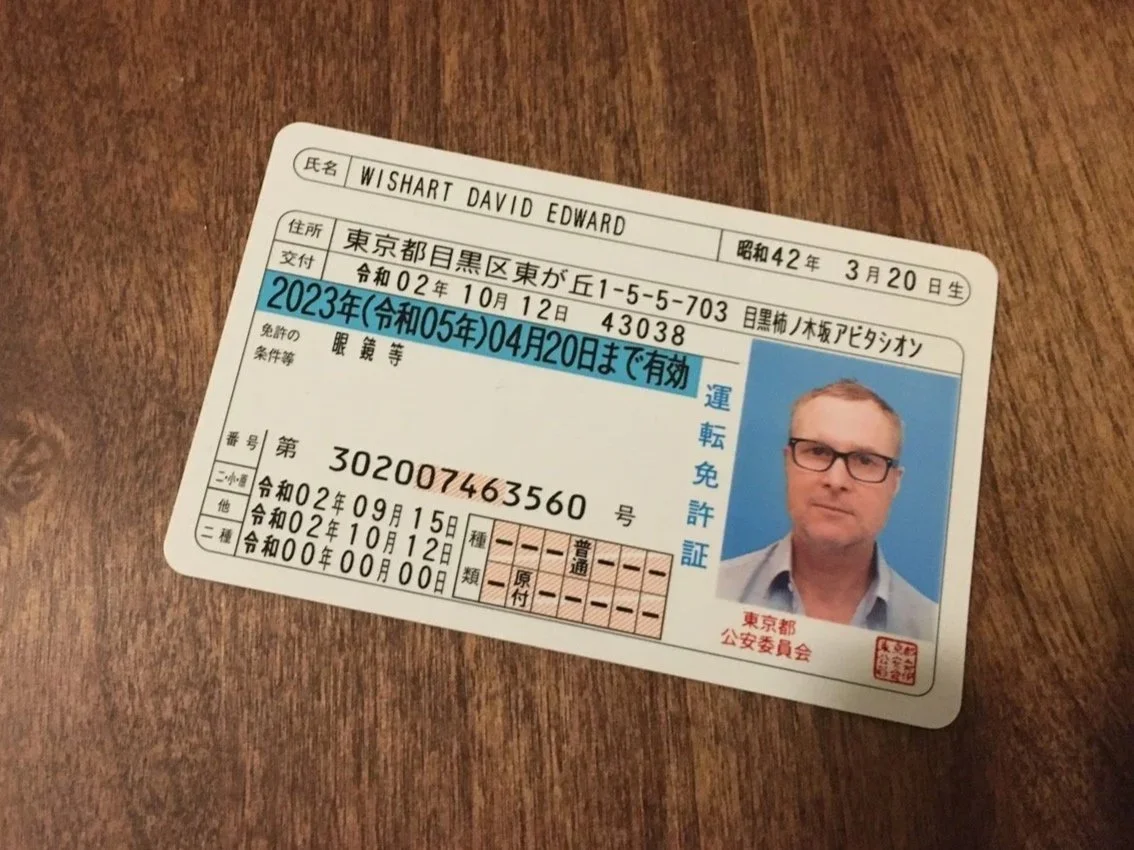
My Japanese Driver’s License
In Japan, driving feels calm and secure. Roads are immaculate, signs are clear, and cars receive mandatory safety inspections. The drivers around me have all passed the same unforgiving test I did. We respect the rules. We pay attention and give each other space. We take driving seriously.

Links
because everything in Japan has a mascot
Companies, cities, buses, police departments, even sewer systems. My ward, Meguro, has a moody cat who encourages shopping local.
drive The Japanese Way
This guide outlines the essentials of driving in Japan.
videos of experts practicing on the driving course
Watch someone drive the entire training course.
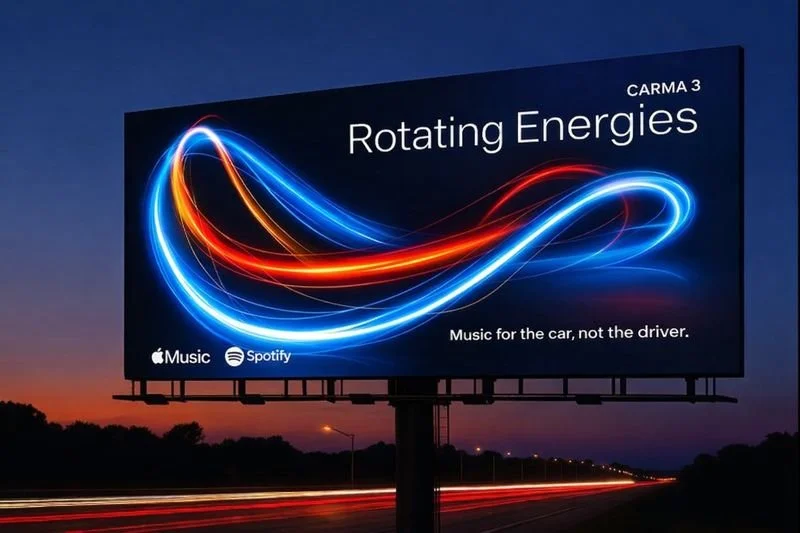
A Sound Bath for Your Car
Is your car not running right despite countless adjustments from your dealer, trusted local mechanic, next-door neighbor, father-in-law, or even by your own machinations? Maybe it’s just a Carmic thought that something isn’t vibing with your beloved vehicle. Trust that instinct. Some automotive ailments require spiritual attention.
That’s why Carmalarky partnered with conceptual artist Sebastian Alvarez, to create Rotating Energies, the world’s first and only Vehicular Sound Bath™. It’s music for the car, not the driver.
Rotating Energies is a full-spectrum audio playlist designed to relieve your car’s stress, cleanse its impurities, and promote harmonic balance throughout its systems.
In the interest of automotive wellbeing, we’re offering Rotating Energies free of charge on two popular music-streaming platforms.
Listen on Apple Music
Listen on Spotify.
Recommended uses: Play Rotating Energies for your car after a meticulous detail, scheduled maintenance, any kind of repair, or a hard day battling traffic. Park in a quiet, safe place. Take a moment to thank your car for carrying you where you’ve needed to go. Start the playlist, then close the garage door softly.
Rotating Energies is suitable for all types of cars, trucks, and motorcycles: old or new, owned, leased, rented, or borrowed.

The Duality of Carmalarky
Carma + Larky
Carma was the original name for our magazine—a playful take on karma that hints at a harmonious balance between cars and humans. We support this relationship. But as a searchable, marketable name that wasn’t already taken, it wasn’t going to work. So we added larky, meaning playful, full of fun, light-hearted. Put together, the name feels energetic and a little mischievous. All good things.
Car + Malarky
Then we noticed a happy accident: Carmalarky also echoes malarkey—good-natured nonsense. Paired with “car,” it becomes “car-related nonsense,” which fits perfectly with our habit of celebrating the quirks, joys, and oddities of car culture.
Love what you’ve read? Share The Carmalarky Dispatch with fellow car lovers, storytellers, and adventurers! Forward this one and tell them to sign up for the next one. Let’s grow the Carmalarky community and celebrate the stories that keep us moving.